
· by Michael Blair, Nashville's Concrete
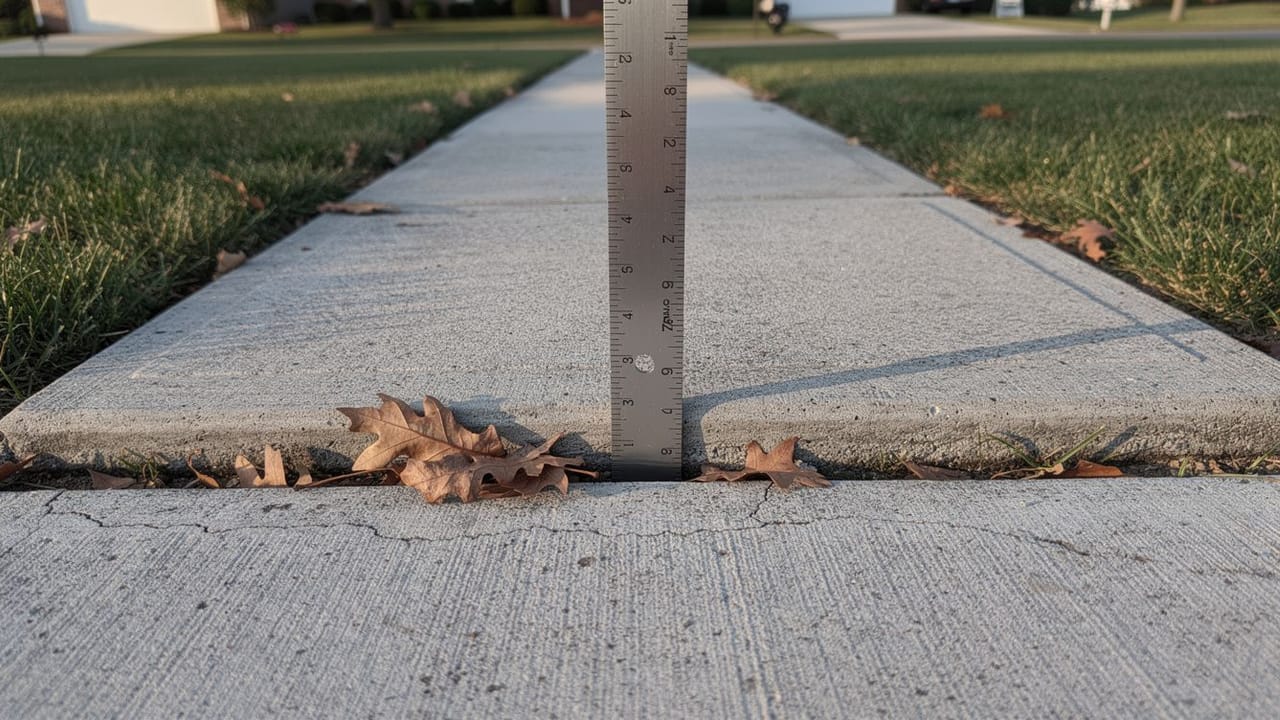
A sidewalk panel drops, the one beside it stays put, and the joint between them becomes a ledge that catches a toe. The question people ask is how high that ledge has to be before it counts as a trip hazard. There is no Tennessee number written for the walk in front of your own house. There are federal accessibility rules with exact limits for public routes, though, and they make a sensible yardstick for deciding whether a settled edge on your front walk needs work and what kind.
How high does a slab edge have to be to count as a trip hazard?
Under the federal accessibility rules, anything over a quarter inch already needs treatment and anything over half an inch needs a ramp. Section 303 of the 2010 ADA Standards for Accessible Design, published by the U.S. Access Board, allows a change in level of up to 1/4 inch to be vertical. Between 1/4 inch and 1/2 inch, the edge has to be beveled with a slope no steeper than 1:2. Above 1/2 inch, the change has to be ramped. The advisory note adds that a half-inch change may be a quarter inch vertical with a quarter inch of bevel on top, but the combined change can never exceed half an inch.
The Access Board’s public right-of-way guidelines (PROWAG), which cover sidewalks along streets, use the same steps in R302.6.2: up to 1/4 inch vertical, 1/4 to 1/2 inch beveled no steeper than 1:2, and a change above 1/2 inch, up to 6 inches, given a slope no steeper than 1:12.
These are accessibility rules for public routes. They are not a legal definition of a trip hazard, and they are not a standard that applies to a private slab at a house. We use them as a reference point because they are the most specific numbers anyone has written down for an uneven walking surface, and because an edge that would fail them on a public walk is one we would not leave on yours.
Does the gap at a joint matter as well as the height?
It can. The same PROWAG technical requirements, in R302.6.3, say joints and openings in a walking surface should not let a sphere larger than 1/2 inch across pass through. A joint that has opened wide enough to take a cane tip, a heel or a stroller wheel is a problem even where the two panels still sit level with each other.
An open joint and a raised lip often show up together, because a panel that settles tends to tip and pull away from its neighbor at the same time. When we measure a walk, we check both: how far the high edge stands above the low one, and how wide the opening between them has become.
Should you lift, grind or replace the panel?
The height of the edge and the cause of the movement decide the repair. The three options work in different directions, and the wrong one either leaves the hazard or creates a new one.
Lifting and grinding are not interchangeable. Lifting raises a sunken panel back up to its neighbor, which is the work of our concrete leveling, and it suits a slab that is still in one piece and sank because the ground under it gave way. Grinding takes the high edge down instead, which suits a small lip and a panel that was pushed up rather than one that dropped. Our post on tree roots lifting a driveway or sidewalk covers the pushed-up case, where foam has no place.
- Under half an inch, in a sound panel: grind the high edge to a bevel no steeper than 1:2
- More than half an inch, panel intact and sunk: lift it back to its neighbor
- Cracked through, broken into pieces or settling again after a lift: repair or replace the panel on a compacted base
- Pushed up by a root: deal with the root first, then grind, bridge or replace
Why a settled edge keeps getting worse
A panel rarely drops all at once. On Middle Tennessee clay, which swells when wet and shrinks as it dries, a slab whose base has started to wash out can sink a little more with each season of rain, and an edge that was a quarter inch one spring can pass half an inch a year or two later. Water running under the low side, often from a downspout or a yard that drains toward the walk, keeps the process going.
That is why we ask where the water goes before we quote. A lift that leaves the same water running under the slab can be undone by the next wet season, and our post on lifting a sunken slab instead of replacing it covers when a panel is still a good candidate for one.
If the uneven sidewalk runs along the street in front of a house in Nashville, NDOT’s sidewalks page takes reports of a damaged sidewalk through its Neighborhood Improvement Tracker, or by calling Metro at 311 or 615-862-5000, and NDOT can tell you how it handles that stretch. For a walk on your own property, send us a photo of the edge with a ruler standing against it and ask for a free estimate; we will tell you whether it can be ground, lifted or needs a new panel.
Sources
- U.S. Access Board, 2010 ADA Standards for Accessible Design, Section 303 Changes in Level — Up to 1/4 inch vertical; 1/4 to 1/2 inch beveled no steeper than 1:2; combined change never over 1/2 inch; over 1/2 inch ramped
- U.S. Access Board, Public Right-of-Way Accessibility Guidelines (PROWAG), Chapter 3 Technical Requirements — R302.6.2 vertical changes on public sidewalks; R302.6.3 openings not to pass a 1/2 inch sphere
- Nashville Department of Transportation, Sidewalks — Reporting a damaged sidewalk through the Neighborhood Improvement Tracker, 311 or 615-862-5000
FAQ
How High an Uneven Slab Edge Is a Trip Hazard — questions
How high does a sidewalk edge have to be to be a trip hazard?
No rule sets a trip-hazard height for a private walk. Federal accessibility rules for public routes allow a quarter-inch vertical edge, require a bevel no steeper than 1:2 between a quarter and half an inch, and require a ramp above half an inch. We use those numbers as a reference point when we look at a settled panel.
Is a 1/2 inch lip in a sidewalk a trip hazard?
Measured against the federal accessibility rules, half an inch is the limit: an edge that tall may only stand if it is beveled, and anything higher needs a ramp. Those rules apply to public routes, not a private slab, but a square half-inch lip on a home walk is worth grinding to a bevel or leveling.
Can you grind down an uneven concrete sidewalk?
Yes, where the lip is small and the panel is sound. Grinding takes the high edge down to a bevel, which the accessibility rules accept up to half an inch of change at a slope no steeper than 1:2. A panel that sank further than that is usually lifted or replaced instead, since grinding cannot remove that much.
Should I lift, grind or replace a settled slab?
It depends on height and condition. A small lip on a sound panel can be ground to a bevel. A panel still in one piece that sank more than half an inch can usually be lifted back to its neighbor. One that is cracked through, broken up or keeps settling after a lift is replaced on a compacted base.
Is a gap in a sidewalk joint a trip hazard?
It can be, even with level panels. The federal guidelines for public sidewalks say joints and openings in a walking surface should not let a sphere larger than half an inch across pass through. A joint that has opened wider than that can catch a cane tip, a heel or a small wheel, so we measure gaps along with height.