
· by Michael Blair, Nashville's Concrete
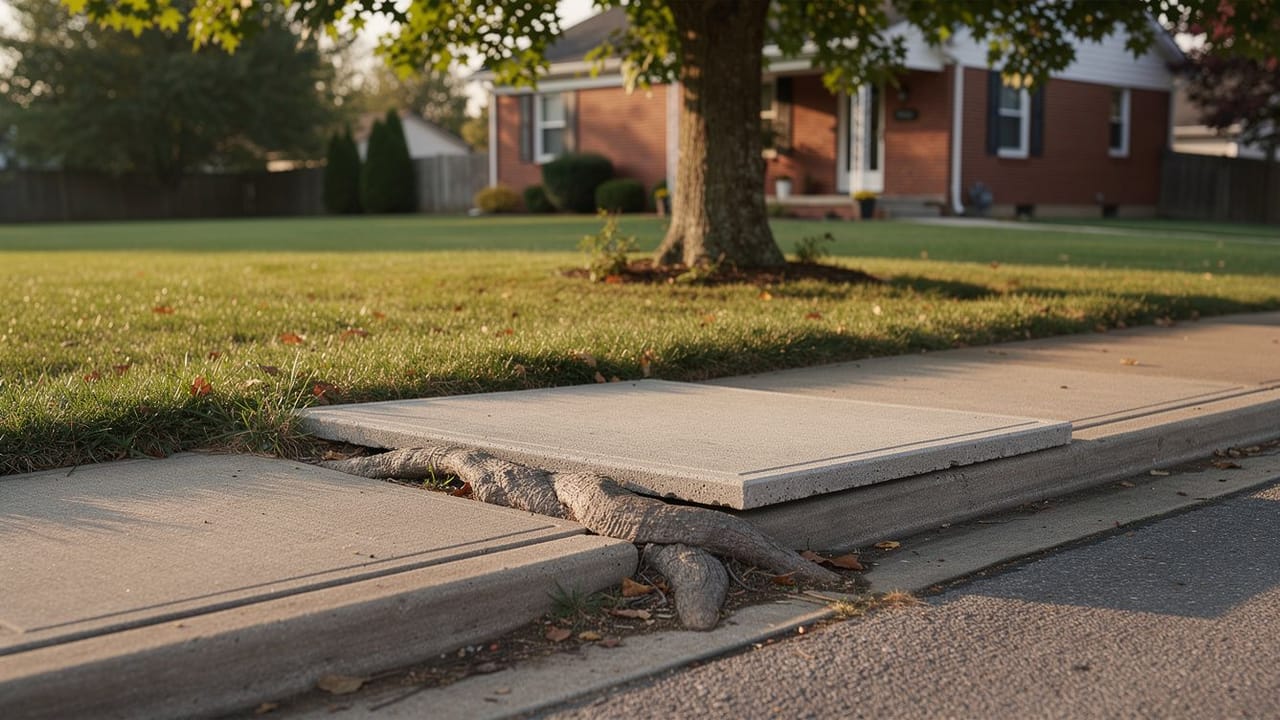
One panel of the front walk has tipped up at a joint and become a trip edge, and there is a maple fifteen feet away. Or the driveway has a hump running across it that was not there five years ago. A slab can also move because the soil under it settled or shifted, but a raised edge close to a tree is a different problem with different repairs. The fix has to deal with the root and keep the tree alive, and on a sidewalk by the street it may not be yours to fix at all.
Why roots end up under concrete
The explanation usually given is moisture: a slab slows evaporation from the soil beneath it, and the seam between the concrete and its base leaves a root room to spread. We have not seen that measured, and it does not change the repair. What matters is that a root keeps growing. Penn State Extension’s article on girdling roots makes the point for roots that wrap a trunk: a small one left alone only grows into a bigger problem. A root under a slab thickens too, and the concrete above it takes the load.
We do not keep a list of guilty species. What we look at first is where the tree stands. A large tree in a narrow strip between the walk and the street, or a few feet off the edge of a drive, is our first suspect when a panel near it starts to rise, whatever kind of tree it is.
How can you tell a root lift from soil movement?
What points to a root is a lift that is local and one-sided. The high edge faces the tree, it is often at a joint or a crack, and the panel tilts up rather than sinking. Sometimes the root itself shows at the edge of the slab or in the lawn beside it. What points the other way is movement spread over several panels or the whole slab, or movement that seems to come and go with wet and dry spells; that is a soil question, and we treat it as one.
The difference matters because the repairs run in opposite directions. A slab that sank is raised or replaced on a better base, which is the job of our concrete leveling work, and our post on lifting a sunken slab instead of replacing it walks through that choice. A panel a root has pushed up needs its high edge brought down. Lifting foam only raises concrete, so we do not inject it under a root-lifted slab; the root gets dealt with first.
Repairs that do not kill the tree
Before anyone takes a saw to a root, find out what that root is doing for the tree. The guidance in Penn State Extension’s girdling-root article is that a root over about 2 inches across should be seen by a Certified Arborist, since a root that size may have become structurally important, and the author notes that cutting one can bring some dieback in the crown. That article is about roots circling a trunk rather than roots under a walk, but the caution carries over, and we would rather give up a section of walk than a mature tree. When to cut, and how much, is the arborist’s call.
The concrete side of the repair then has several options, on a drive or a front walk alike, and the right one depends on how big the root is and how close the tree stands.
- Grind the trip edge down where the lift is small and the tree must stay untouched
- Remove the panel, prune the root on an arborist’s advice, and pour a new panel with a root barrier
- Bridge over a root that cannot be cut with a reinforced, thickened slab
- Curve the walk or drive away from the tree, or switch that section to pavers that can be reset
Who owns the sidewalk in front of a Nashville house?
Metro’s right-of-way maintenance page describes the right-of-way as land the city owns or controls for streets, alleys, sidewalks and bike paths, and NDOT’s sidewalk page says the department is responsible for every aspect of Nashville’s sidewalks, repairing damage included. So the walk along the street may not be yours, even though you mow beside it. The same sidewalk page takes reports of a damaged sidewalk through hubNashville, and Metro answers at 311 or 615-862-5000.
Fixing it yourself, or paying someone to, is a separate question. NDOT’s permits page says right-of-way permits are applied for through ePermits, at least 2 business days before work starts unless it is an emergency repair. That page does not spell out curbs, driveway aprons or the roots of a tree in the strip, so ask NDOT before any of those are touched. In Franklin, Brentwood, Murfreesboro or another city, ask that city before work starts.
On your own drive and walk, the choice is yours. When we replace a lifted panel, the base gets compacted and the root barrier set before the forms go in, because a root left under new concrete keeps growing and could lift the new panel the way it lifted the old one. If the pour is headed into cold or wet weather, our post on weather that ruins a concrete pour covers what that does to a fresh slab. To have a raised panel looked at, ask us for a free estimate.
Sources
- Penn State Extension, Girdling Roots: To Cut or Not to Cut — Roots keep growing; roots over about 2 inches go to a Certified Arborist as they may be structurally important; cutting can cause some crown dieback (girdling-root context)
- Metro Nashville NDOT, Right-of-Way Maintenance — The right-of-way is land the city owns or controls for streets, alleys, sidewalks and bike paths
- Metro Nashville NDOT, Sidewalks — NDOT responsible for all aspects of Nashville’s sidewalks, including repairing damage; report a damaged sidewalk through hubNashville, 311 or 615-862-5000
- Metro Nashville NDOT, Permits — Right-of-way permits applied for through ePermits at least 2 business days before work starts, unless an emergency repair
FAQ
Tree Roots Lifting a Driveway or Sidewalk — questions
Can I cut a tree root that is lifting my driveway?
Penn State Extension, writing about girdling roots, says a root under about 2 inches across can usually be cut, while one over 2 inches should be checked by a Certified Arborist because it may have become structurally important, and cutting a large root can cause some dieback. If the tree stands in the public right-of-way, check with the city before cutting anything.
Who fixes a sidewalk lifted by a city tree in Nashville?
Metro Nashville’s Department of Transportation says it is responsible for Nashville’s sidewalks, including repairing damage, and work in the public right-of-way needs a right-of-way permit applied for through ePermits. Report a damaged sidewalk through hubNashville, 311 or 615-862-5000, and ask NDOT before doing any repair of your own.
Will a root barrier stop roots from lifting new concrete?
We set a barrier along the edge of a new panel to steer roots away from its underside, but we have not found independent research on how well barriers hold up over the years that we would quote. What a barrier cannot do is help with a root already under the slab, which has to be pruned on an arborist’s advice or bridged first.
Can tree roots lift a driveway?
Yes. A root under a slab keeps thickening as it grows, and the concrete above it takes the load, so a panel near a tree can tip up at a joint with its high edge facing the trunk. Movement spread across several panels, or coming and going with wet and dry spells, points to the soil instead.