
· by Michael Blair, Nashville's Concrete
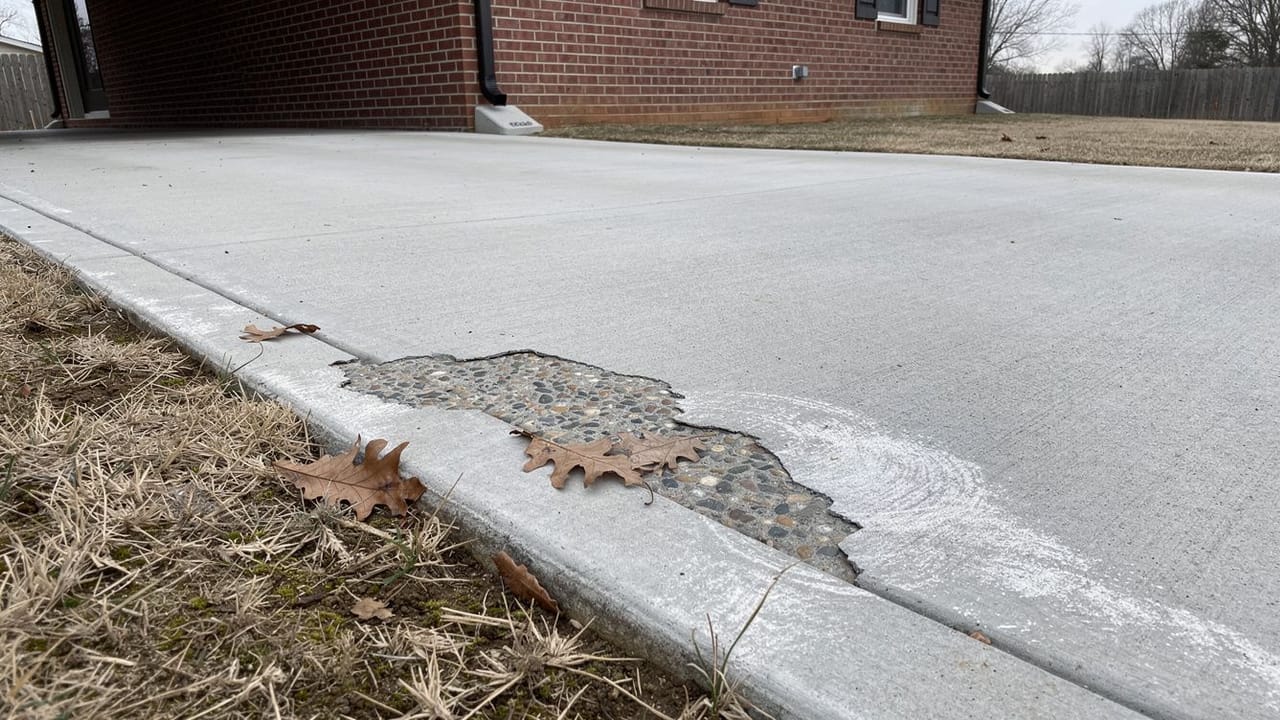
A concrete driveway or patio that looks fine the week it is poured can show its problems by the second season. Three surface complaints come up again and again: a surface that dusts off as fine powder, a surface that flakes away in thin patches, and a white deposit that appears and reappears. They look related. Dusting and scaling usually go back to how the slab was finished and cured on the day it was poured, and the worst cases leave a surface that will not last. The white bloom comes from water moving through the concrete, and on its own it is the mild one.
Why does new concrete dust?
A slab that dusts has a weak surface layer, and the usual cause is finishing too soon. Bleed water is the film of water that rises to the top of freshly placed concrete as the heavier particles settle, and the National CP Tech Center’s manual on concrete construction practices says that finishing with bleed water still present creates a thin, weak layer on the surface that is prone to scaling and delamination. The same manual notes that any extra water in the mix means more bleed water, and that heavy bleeding raises the water-to-cement ratio at the surface and weakens it.
Adding water or cement to the surface while finishing does the same damage. The Bureau of Reclamation’s Guide to Concrete Repair lists overfinishing and adding water, cement or other substances during finishing as the usual finishing defects, and says the surface left behind can be porous, permeable or low in durability. A finisher shaking dry cement over a wet slab to soak up the water is doing exactly that.
Dusting lives in the top layer, the part the finisher worked. On a garage floor or driveway with light dusting, we try a penetrating densifier on a test patch first and see whether the powdering stops. Where the top is soft enough to scratch away with a key, we do not expect a treatment to save it; that layer will wear through, and the fix is grinding it off and resurfacing. Our garage slab page covers how we pour and finish a floor so it does not start out this way.
Scaling: patches that flake away
Scaling is the surface breaking off in thin flakes and exposing the stone below, and it tends to show up after freezing weather. According to the Bureau of Reclamation repair guide, freeze-thaw damage needs three things at once: cycles of freezing and thawing, concrete that is saturated or nearly so, and concrete without an adequate air void system. Middle Tennessee supplies the first. Nashville averages 67 days a year with a low at or below freezing, between an average first freeze around November 11 and a last one around March 31, according to the National Weather Service’s Nashville climate records. The air void system is the tiny bubbles entrained in exterior concrete on purpose, which the CP Tech Center manual describes as space for freezing, expanding water to move into.
Deicing salt makes it much worse. The CP Tech Center manual explains that salt in solution soaks into the surface, can crystallize as it dries, and concentrates where water freezes, drawing more water toward that spot; the pressures crack and scale the surface. It also cites research finding that weak salt solutions, around 2 to 4 percent sodium chloride, do more damage than strong ones, so a light sprinkling is no safer than a heavy one.
The finishing mistakes behind scaling overlap with dusting. Troweling a surface tight while bleed water is still coming up can seal the top and trap that water beneath it, which the CP Tech Center manual says can form blisters, and the Bureau of Reclamation guide notes that its own specifications do not allow a steel trowel finish on air-entrained concrete exposed to freezing and thawing. Our exterior flatwork gets air-entrained concrete, a broom finish and a curing compound. We also ask owners to keep salt off it through the first winter, in line with the manual’s advice to delay salt until the concrete is mature, preferably several months.
Scaled concrete does not grow back. The Bureau of Reclamation guide describes repairing a poorly finished, spalling surface as removing the weakened concrete and replacing it, with a packaged repair material or with new concrete. On a driveway that is otherwise sound, that means grinding off the loose top and resurfacing. Where the flaking runs across the whole slab, our concrete repair and replacement page explains how we decide between the two.
- Bleed water finished into the surface: a weak top layer that dusts or scales
- Water or dry cement added during finishing: a porous, low-durability surface
- Troweled tight while bleed water was still rising: blisters under the skin
- No proper air void system, or salt on it while young: scaling
- Late or patchy curing in sun and wind: plastic shrinkage cracks and a surface that wears faster
What is the white film on new concrete?
The white film that appears on new concrete, and often on the block wall beside it, is efflorescence, which the National Park Service’s preservation brief on concrete describes as soluble salts deposited on the surface as a result of water migrating through it. The deposit sits on the surface, and on its own it brushes away.
What it tells you is that water is moving. Bloom that keeps coming back in the same patch means water keeps reaching that part of the slab, so we look for where it comes from: a low spot that holds water, a downspout emptying against the edge, soil sloped toward the slab. For removal, the painting specification at the back of the Bureau of Reclamation guide calls for scraping or wire brushing first, then washing with a 5 to 10 percent muriatic acid solution and rinsing with fresh water within five minutes. Brushing it off dry is where we start, and often where we stop.
Hold off on sealer while it is still blooming. Moisture trapped under a sealer is one cause Euclid Chemical’s sealer troubleshooting bulletin gives for a solvent-based cure and seal turning white and losing its grip on the concrete, and the fixes it lists run from a solvent wash to stripping the sealer off.
What to watch on the day of the pour
Dusting and scaling are mostly decided on the day the slab goes in, and most of the prevention is visible if you are there. The crew should wait for the sheen of bleed water to go before floating and troweling, which is the moment the Federal Highway Administration’s tech brief on curing describes as the surface starting to dry. An exterior slab should get a broom finish. Curing should start as soon as finishing is done, with a sprayed curing compound or wet coverings, and the FHWA brief warns that poor curing leaves a surface that is more permeable and wears faster, with a higher risk of plastic shrinkage cracking. Our post on weather that ruins a concrete pour covers the hot, cold and windy days when this goes wrong fastest.
If you are reading this after the fact, test the surface with a key, keep salt off it, and wait on sealer. Euclid’s data sheet for its Baracade WB 244 penetrating sealer asks for new concrete to cure at least 7 days and for the surface to be dry for 24 hours before application, and says a longer cure gives better results; on a slab that is still blooming we wait well past that. Our post on sealing a concrete driveway covers timing and products. A lightly dusting surface can sometimes be treated. One that is scaling in patches is a conversation with the contractor about resurfacing, and about what was done on the day, and if you want another set of eyes on it first, ask us to come look.
Sources
- National CP Tech Center, Iowa State University, Integrated Materials and Construction Practices for Concrete Pavement, 2nd ed. (2019) — Bleed water definition; finishing with bleed water leaves a weak layer prone to scaling; extra water means more bleeding and a weaker surface; troweling over rising bleed water forms blisters; air voids give freezing water room; how deicing salt causes scaling; 2 to 4 percent salt does more damage; delay salt until the concrete is mature
- U.S. Bureau of Reclamation, Guide to Concrete Repair, 2nd ed. (2015) — Finishing defects from overfinishing or adding water or cement; the three conditions for freeze-thaw damage; no steel trowel finish on air-entrained concrete exposed to freezing; repair by removing weakened concrete; efflorescence removal by wire brush and dilute muriatic acid
- National Weather Service Nashville, Climate Records (BNA) — An average of 67 days a year with a low at or below 32 degrees; average first freeze November 11, last March 31
- National Park Service, Preservation Brief 15: Preservation of Historic Concrete — Efflorescence is soluble salts deposited on the surface as water migrates through the concrete
- Federal Highway Administration, Tech Brief: Curing Concrete Paving Mixtures, FHWA-HIF-18-015 (2018) — Loss of bleed-water sheen as the surface starts to dry; curing right after finishing; poor curing raises permeability, lowers wear resistance and risks plastic shrinkage cracking
- Euclid Chemical, Technical Bulletin CP-05: Concrete Sealer Troubleshooting — Moisture trapped under a solvent-based cure and seal turns it white and costs it adhesion; solvent wash or stripping as the fix
- Euclid Chemical, Baracade WB 244 Technical Data Sheet — Cure new concrete at least 7 days and let the surface dry 24 hours before sealing; a longer cure gives better performance
FAQ
Why New Concrete Dusts, Flakes or Turns White — questions
Is white powder on new concrete a problem?
The white powder is usually efflorescence, salts left on the surface as water moves out through the concrete. The deposit itself brushes off. If it keeps coming back in one place, water keeps reaching that part of the slab, and the drainage around it, such as low spots and downspouts, is the thing to look at.
Why is my new concrete driveway flaking?
The surface is scaling. The usual causes are a weak top layer from finishing while bleed water was on the surface, concrete without a proper air void system, and deicing salt on a slab that freezes while wet. The flakes will not reattach. A sound slab can have the loose top ground off and be resurfaced; widespread scaling can mean replacement.
Should I seal a new concrete driveway right away?
No. The slab needs to cure and dry first, and one penetrating sealer maker asks for at least 7 days of curing and a dry surface, with longer cures giving better results. Do not seal while white bloom is still appearing, because moisture trapped under a sealer can turn it white and make it lose its grip.
How do you fix flaking concrete?
Scaled concrete never grows back, so the weakened top has to come off and be replaced. On a slab that is otherwise sound, we grind away the flaking surface and resurface it; when the flaking covers the whole slab, replacement can be the better call. Keep deicing salt off the repaired surface through its first winter.